
Water security a top priority for CVRD director candidates
Water security is a key issue for candidates running for regional director of electoral areas A, B, and C in Saturday’s local election.
In this year’s election, Daniel Arbour was acclaimed as director for Area A, which includes Baynes Sound, Denman and Hornby Islands. Area B, or Lazo North, has two candidates: incumbent Rich Hardy and Arzeena Hamir. In Area C, which covers Puntledge and Black Creek, three candidates are running: Gillian Anderson, Ariel Becherer and Norm McPhail.
Area C Candidate Ariel Becherer said she’s hearing concerns from residents about water, affordability and the impacts of growth on the region’s rural communities.
“ I hear a lot on water. And I hear a bit, after water, a lot of folks in Area C wanting things to stay rural to protect land and water, and then I hear affordable housing, affordable food, price of gas and a lot on road safety.”
Becherer worked at the Black Creek Community Centre and has a background in political economy. She proposed rebates for rain barrels and cisterns as a first step toward improving water conservation and coordinating long-term water planning across the valley.
“ So for starters, simple, achievable, we can do what other regional districts are doing. So other regional districts have systems for people who want to put in rain barrels, some financial help for them. So we can set up that rebate system in the valley, and if we set it up so it’s valley-wide, then that sets us up for much better long-term water planning.”
Area B candidate Arzeena Hamir said water security is also a key priority for residents in her electoral area. She wants the CVRD to provide more support for water storage solutions and invest in rainwater harvesting, as well as promote conservation through education and incentives for efficient irrigation.
Area C candidate Gillian Anderson said the regional district needs a comprehensive plan that considers the needs of farmers, residents and local ecosystems.
“I think what we need to do is put together a meaningful plan to manage the water in the valley with really meaningful community input from farmers, and ecologists, so that we can safely and adequately, manage water for farms and water for salmon, because we just can’t keep lurching from crisis to crisis. And we need to restore our watershed. We need to get control of the watershed and start planting again, getting some trees back on that soil. That’s one of my immediate concerns if I’m elected.”
Anderson is on the committee of Save Our Forests Team Comox Valley. She said she’s concerned about how climate change and logging practices are affecting the region’s watersheds and water supply, which also impacts local rivers and salmon populations.
“A few summers ago, the river level dropped so low that the salmon were at risk and the province brought in an emergency stop watering order for some farms. And of course it was completely unexpected and farmers had to stop irrigating and they lost some of their crops as a result. And of course we’ve seen such extensive logging in the valley that there’s really nothing left holding the water on the land anymore. And we can’t have healthy rivers and lakes if we take all the trees off the land, and we can’t keep lurching from crisis to crisis with our salmon and farming communities.”
Becherer proposed a permanent farmers’ market building to counter rising grocery costs.
“In terms of spending, a teeny bit more spend on what is, the CVEX line, so the Comox Valley Exhibition Grounds, because some of the farmers want to see a sensibly sized, modest, permanent building of some sort for the farmers’ market grow up there. And while not sufficient, we really have to do something on grocery prices, something to unmake the monopoly of the grocery store giants. And so building this building for our local farmers’ market is one step that we can take towards making food prices a bit more affordable or at least giving us more control on our own terms over our food systems.”
Anderson said she would prioritize water conservation and infrastructure upgrades in the budget.
“I think we need to prioritize water management and conservation and restoring the watersheds. So we need to put some money into that and continuing with the infrastructure upgrades. I’ll always applaud spending money on park acquisition because a community without parks isn’t much of a community to live in. And once a potential park or conservation site is lost, it’s lost forever.”
Becherer said the regional district has begun the process of reviewing its assets and infrastructure, but believes more proactive planning is needed.
“ The regional district has also started a review of all their assets. They are going over everything they own. So because they’ve done that review, looking back 50 years, looking ahead 50 years, that is incredible, essential work that I’m glad they did. But I think they needed to be far more proactive on long-term water security planning and housing planning.”
Road safety is another concern Anderson said she’s hearing from residents, particularly along Highway 19A.
“ I’m also hearing about traffic concerns in general, but especially with Highway 19A, which is the old highway that runs to town. There’s been a phenomenal amount of development in Campbell River and throughout the Comox Valley, and a lot of that traffic piles onto Highway 19A. And people are barreling along often well past the posted 80 kilometre speed. And some of the access intersections that were designed for traffic needs decades and decades ago are really becoming areas for safety concerns. So the CVRD really needs to lobby the provincial government to do some upgrades to this highway.”
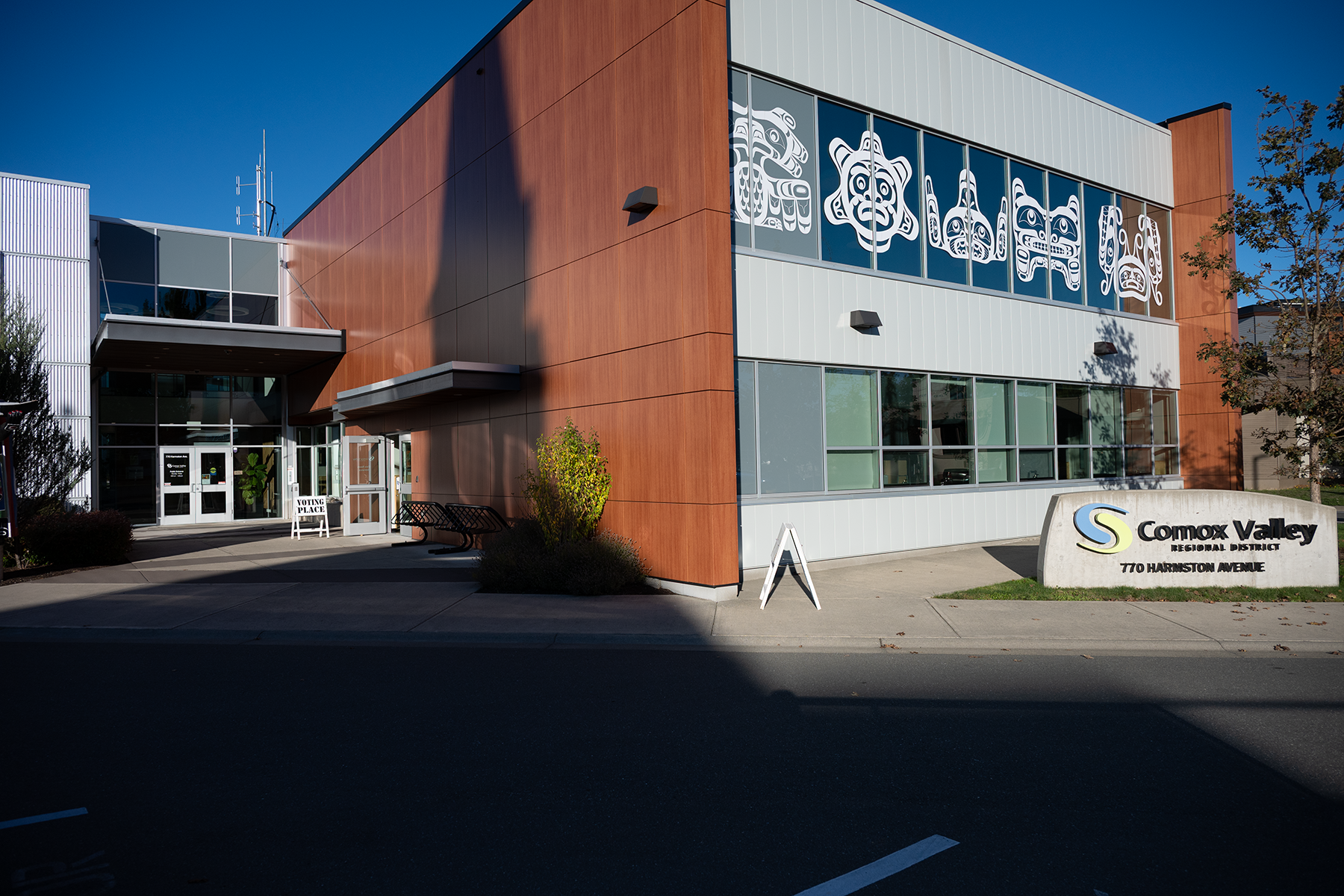
Voters in all areas can vote Saturday at the CVRD Civic Room at 770 Harmston Avenue in Courtenay from 8:00 a.m. to 8:00 p.m. For more information, visit comoxvalleyrd.ca.
Funding Note: This story was produced with funding support from the Local Journalism Initiative, administered by the Community Radio Fund of Canada.